

Dawn of new industry
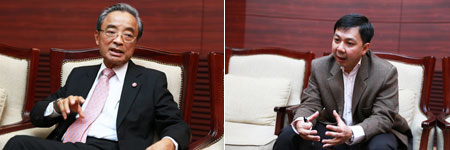 |
| Prof. Pairash Thajchayapong, left, a senior advisor for the Ministry of Science and Technology of Thailand, and Prof. Ang Wei Tech of Singapore, right, an expert in robotics for assistive and rehab technology, speak during an interview at KINTEX in Ilsan, Gyeonggi Province, on Aug. 27.
/ Korea Times photo by Yoon Sung-won |
Mechanical aids to become hot items for Korea’s rapidly aging population
By Yoon Sung-won
Korea is one of the fastest aging societies in the world amid the rapidly falling birthrates and expanding life expectancy. According to Statistics Korea, nearly 12 percent of the Korean population is now aged 65 or older. The ratio is projected to jump to 20 percent in 2026 and further to 38.2 percent in 2050, making Korea the world’s most aged society.
With Korea’s population aging in an unprecedented rate, the demand for assistive technology for the elderly and the disabled will increase sharply. The technology includes such items as walking aids, hearing aids, portable urinals, motorized wheelchairs and prostheses for arms and legs.
Against such a backdrop, the Ministry of Health and Welfare recently organized the Senior and People with Disability Expo (SENDEX), an international trade fair for senior industry, health, rehabilitation and assistive technology at KINTEX in Ilsan, Gyeonggi Province. This year’s event was held from Aug. 28 to 30 with the participation of more than 200 companies and organizations, as well as six representatives of Asian countries.
During the expo, The Korea Times interviewed two of the big names who have contributed most to making the exhibition successful. They are Professor Ang Wei Tech of Singapore and Professor Pairash Thajchayapong of Thailand.
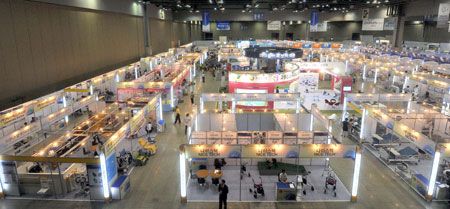 |
| Panorama of the event hall for the Senior and People with Disability Expo (SENDEX), an international trade fair for health, rehab and assistive technology at KINTEX in Ilsan, Gyeonggi Province. Courtesy of SENDEX |
Ang Wei Tech is a professor at the Nanyang Technological University’s Division of Engineering Mechanics and the director at the School of Mechanical & Aerospace Engineering in Singapore. He is also an activist who promotes technology to empower the disabled and the elderly to live an independent life.
Prof. Pairash is a senior advisor at the National Science and Technology Development Agency (NSTDA) and the Ministry of Science and Technology of Thailand. His research ranges from prostheses, speech assessment, hearing aids and medical image processing for dental applications.
In the interview, they shared their perspectives on the present and the future of assistive technology for the elderly and the disabled.
Prof. Ang Wei Tech
Q What is the topic of your speech this year?
A This year I’ll focus on the challenges that the development of assistive and rehab technology faces.
The development of assistive and rehab technology involves five different groups of stakeholders ― the elderly and people with disabilities; clinicians, doctors and therapists; scientists, researchers and engineers; companies; and policymakers, including governments and NGOs. Making agreements from all these five groups is not easy.
More importantly, the development of assistive and rehab technology is not significant enough because market forces are missing in the field. Unlike spectacles and treadmills, two of the mainstream products that are selling well, markets for other assistive and rehab devices are not mature yet.
On the other end, assistive and rehab technology is not considered important enough compared to other medical fields such as neurosurgery and cardiac surgery, since rehab is not the frontline discipline that saves lives.
One thing is for sure, it’s hard for me to imagine that someone will win a Nobel Prize for medicine in rehab while people in neuroscience or cardiac science might possibly.
It’s also true that medical doctors, like neurosurgeons, make at least three to four times more money than rehab doctors in the same level of seniority. This is happening in Singapore, in the U.S. and in many other parts of the world.
Q Why do you think the assistive and rehab technology lacks profitability, even though the potential consumer need is larger than the market? And what can be a possible breakthrough?
A To explain that, let me come up with an example. There is a device called a speech aid which is designed to help people with difficulty communicating with others. These products cost more than $10,000 for one unit. Why do they have to be so expensive? The reason is because the market size is too small. It’s not like smartphones that sell in billions of units a year.
In terms of the economy of scale, only a few people buy a product when it’s expensive, and consequently the sales will be low. The manufacturers of these products cannot sell them cheaper either, because they cannot make money in that way. Because of this vicious cycle, it became a tough business and most of the companies in this field don’t make money.
This has been true for many years, but things are starting to change. More people are using mainstream technology such as tablet computers. With such devices, people can download apps for only tens of dollars and these apps work almost the same as the device that can cost more than $10,000. The cost can actually come down as mainstream devices become more popular.
Therefore, assistive and rehab technology should integrate and customize such mainstream technologies. In this way, I believe we can get to the economy of scale.
Q What do you think the future of robotics technology will be?
A There are two perspectives over the future of robots. One side believes future robots will be human-like super-beings, like what we see in the sci-fi movies. Another side thinks that devices and appliances will each have robot-like intelligence and work as one team. The robotics industry calls the former a centralized system and the latter a distributed system.
While the technology to build a super-being robot will be highly complicated and expensive, realizing the distributed system is much easier and yet costs less. Electronics giants like Samsung Electronics and Sony, which have more control over the market, will naturally find more profitability from the latter. That I see is the future of the robotics technology and its market.
In fact, only the Japanese believe in humanoid robots. Americans don’t like the idea of humanoid robots. In countries such as Taiwan, Singapore, Hong Kong and Malaysia, when elderly at home need help, people hire a maid who can do the same things as a robot, but more cheaply.
Robotics technology is fast becoming the mainstream, and the price has recently been going down. But there still is a long way to go to bring robots to help the elderly and people with disabilities at home.
Prof. Pairash Thajchayapong
Q What is the topic of your speech in this year’s convention?
A In this year’s presentation, I’ll talk about Thailand’s effort in supporting people with disabilities and in exchanging experiences on assistive technology and rehab engineering with other countries.
Q You are a senior advisor at the National Science and Technology Development Agency (NSTDA) of Thailand. Please introduce what the agency does and what is your mission in your position.
A The NSTDA is an organization attached to the Ministry of Science and Technology of Thailand. Consequently, the agency’s mission concerns with research and development of science and technology.
Generally speaking, what we do consists of four major parts; research and development; expanding national infrastructure for science; transferring technologies to the private sector and to other countries; and developing human resources.
The agency holds science camps for young talents in Thailand and establishes student exchange programs with other countries.
During the visit to Korea this year, I talked with Sungkyunkwan University to set up exchange programs for doctoral degrees and to do some collaborative research projects in the area of nanotechnology.
Q Please give us a brief introduction to your specialty, medical image processing technology regarding computerized X-ray scanners for dental applications.
A I studied signal processing for my doctoral degree. Afterwards, I tried to connect my expertise in digital image processing to the medical applications.
For example, the computed tomography scanner, or CT scanner, is a very useful device that can produce images of specific areas of our body using computer-processed X-rays.
However, it is too big to be used for specific parts of the body, say, teeth. So I devised a smaller CT scanner that is designed specifically for dental scanning. The device is capable of producing 3D images that are used to better plan dental implants for elderly patients.
Currently Thailand has built two of these units. One is installed in the Chiang Mai University and the other one is in a private clinic. So far, they have been used for more than 400 patients. This technology may not be cutting-edge in some advanced countries. But they are new in Thailand and are actually benefiting Thai people.
Q Thai Princess Maha Chakri Sirindhorn, daughter to the King Bhumibol Adulyadej of Thailand, is recognized to have contributed much on the development assistive and rehab technology in the country. Please elaborate about her and her achievements in the field.
A Because of her concern for underprivileged people, the princess has helped people in remote areas, the elderly and people with disabilities. For example, she provided computers and Internet services to people who live under dire circumstances in the border areas of Myanmar, Laos, Malaysia and Cambodia, and helped them to live a self-sufficient life by teaching them farming.
Another example is her support of the International Convention on Rehabilitation Engineering and Assistive Technology (i-CREATe), which was proposed by Prof. Ang Wei Tech. She not only provided financial support for the convention, but also significantly contributed to its promotion in other countries. As a matter of fact, she herself helped the convention become recognized as royal
The convention gathered young, talented researchers of assistive and rehab technology and encouraged them to come up with new inventions.
So far, more than 50 innovative products have been commercialized. By supporting the convention, the princess not only created international awareness but also turned the research into commercial products.
Q As an expert in the elderly and the disabled, what would you suggest to improve a nation’s healthcare policies?
A First, laws should comfort people with difficulties. Thailand’s legal system, including the constitution, includes provisions that support the elderly and people with disabilities.
For example, Thai private companies are obliged to provide job opportunities for the disabled, and, if the companies cannot do it, they have to donate money to establish a public fund for people with disabilities.
As the life expectancy is estimated to become longer, extending the retirement age is also to be recommended. It not only will be a necessary measure for the aging society, but it also can act as a new driving force to the national economy.
Lastly, I would say that private and public cooperation in developing assistive and rehabilitation technology and related devices is important.
Once the government supports the development of such technologies and transfers them to the private sector, it can lead companies to produce the assistive devices and get them on the market, thereby making them more widely available for sale.
ประเภทข่าว
แหล่งข้อมูลข่าวเศรษฐกิจ
- กรมเศรษฐกิจระหว่างประเทศ กระทรวงการต่างประเทศ
- ศูนย์ข้อมูลเพื่อธุรกิจไทยในจีน
- ศูนย์ข้อมูลเพื่อธุรกิจไทยในอาร์เจนตินา
- ศูนย์ข้อมูลเพื่อธุรกิจไทยในแคนาดา
- ศูนย์ข้อมูลเพื่อธุรกิจไทยในชิลี
- ศูนย์ข้อมูลเพื่อธุรกิจไทยในเม็กซิโก
- ศูนย์ข้อมูลเพื่อธุรกิจไทยในออสเตรเลีย
- ศูนย์ข้อมูลเพื่อธุรกิจไทยในเมียนมาร์
- ศูนย์ข้อมูลเพื่อธุรกิจไทยในรัสเซีย
- ศูนย์ข้อมูลเพื่อธุรกิจไทยในสหรัฐอาหรับเอมิเรตส์
- ศูนย์ข้อมูลเพื่อธุรกิจไทยในบราซิล
- ศูนย์ข้อมูลเพื่อธุรกิจไทยในเยอรมนี
- ศูนย์ข้อมูลเพื่อธุรกิจไทยในเดนมาร์ก
- ศูนย์ข้อมูลเพื่อธุรกิจไทยในอียิปต์
- ศูนย์ข้อมูลเพื่อธุรกิจไทยในฮังการี
- ศูนย์ข้อมูลเพื่อธุรกิจไทยในนอร์เวย์
- ศูนย์ข้อมูลเพื่อธุรกิจไทยในปากีสถาน
- ศูนย์ข้อมูลเพื่อธุรกิจไทยในสหรัฐอเมริกา
- ศูนย์ข้อมูลเพื่อธุรกิจไทยในศรีลังกา
- ศูนย์ข้อมูลเพื่อธุรกิจไทยในอินเดีย
- ศูนย์ข้อมูลเพื่อธุรกิจไทยในอิหร่าน
- ศูนย์ข้อมูลเพื่อธุรกิจไทยในสิงคโปร์
- ศูนย์ข้อมูลเพื่อธุรกิจไทยในเกาหลีใต้
- ศูนย์บริการข้อมูลธุรกิจไทยในฟิลิปปินส์
- ศูนย์ข้อมูลเพื่อธุรกิจไทยในมาเลเซีย
- ศูนย์ข้อมูลเพื่อธุรกิจไทยในลาว
- ศูนย์ข้อมูลเพื่อธุรกิจไทยในญี่ปุ่น
- ศูนย์ข้อมูลเพื่อธุรกิจไทยในอินโดนีเซีย
- ศูนย์ข้อมูลเพื่อธุรกิจไทยในไต้หวัน
- ศูนย์ข้อมูลเพื่อธุรกิจไทยในเวียดนาม
- ศูนย์ข้อมูลเพื่อธุรกิจไทยในยุโรป
- ศูนย์ข้อมูลเพื่อธุรกิจไทยในแอฟริกาใต้
- ศูนย์ข้อมูลเพื่อธุรกิจไทยในเซเนกัล
- ศูนย์ข้อมูลเพื่อธุรกิจไทยในเนปาล
- ศูนย์ข้อมูลเพื่อธุรกิจไทยในมาดากัสการ์
- ศูนย์ข้อมูลเพื่อธุรกิจไทยในคูเวต
- ศูนย์ข้อมูลเพื่อธุรกิจไทยในอิสราเอล
- ศูนย์ข้อมูลเพื่อธุรกิจไทยในอาเซียน